Which Lishi Tool Do I Need? A 2026 Selection Guide
Buying the wrong Lishi tool is an expensive habit. At $30–50 per tool, a wrong guess costs a job, a return, and another wait for delivery. The good news is that Lishi naming is not random: once you know four things about the lock in front of you, the right model is usually obvious.
This is the same four-step check we use when a locksmith sends a photo of a key and asks which tool to order.
Step 1: Identify the lock family
Lishi 2-in-1 tools are organised by lock family, not by vehicle badge. Start by deciding which of these you are working on:
- Automotive — door, ignition or trunk locks
- Residential — Schlage, Kwikset and similar cylinders
- Padlocks and BEST-style systems
- Mailbox locks
- Motorcycle ignition locks
A car key is not automatically an automotive keyway. Some older vehicles and commercial vans use a residential-style cylinder, and the tool family follows the cylinder, not the badge.
Step 2: Read the keyway code
The keyway code is usually stamped on the key head or the cylinder face: HU66, HU92, HU101, TOY43, SC1, KW1. That code — not the car model — is what the Lishi model number refers to.
Look in three places, in this order: the key head, the cylinder face, and the door-jamb sticker. If the key is worn, compare the profile with the Lishi tool finder or the application charts.
Do not infer the keyway from the badge. A Volkswagen Group vehicle may use HU66 or one of three HU162T variants depending on year and model.
Step 3: Count the cuts
Cut count is part of the tool's identity, not a marketing detail. Common counts are 5, 6, 7, 8, 9, 10 and 12. If you order an 8-cut tool for a 10-cut keyway, it will not read correctly.
- HU66 — 8-cut
- HU92 — 8-cut
- HU101 — 10-cut
- HU162T — 8-cut (v.3), 9-cut (v.2), 10-cut
- TOY43 — 8-cut; TOY43R and TOY43AT — 10-cut
Step 4: Check the groove direction
Residential cylinders add one more variable: left or right groove. Schlage and Kwikset both have left-groove versions — SC1-L, SC4-L, KW1-L, KW5-L. A right-groove tool will not read a left-groove cylinder correctly, and this is one of the most common return reasons.
Look at the key: the groove runs along one side of the blade. Match the side, then choose the model.
Quick reference by vehicle family
| Vehicle family | Keyway / cuts | Tool to start with |
|---|---|---|
| VW, Audi, Skoda (older) | HU66 · 8-cut | HU66 |
| VW, Audi, Skoda (2015+) | HU162T v.2 · 9-cut | HU162T v.2 |
| BMW, Land Rover | HU92 · 8-cut | HU92 v.3 Direct Read |
| BMW 3 Series | HU58 · 6-cut | HU58 v.3 |
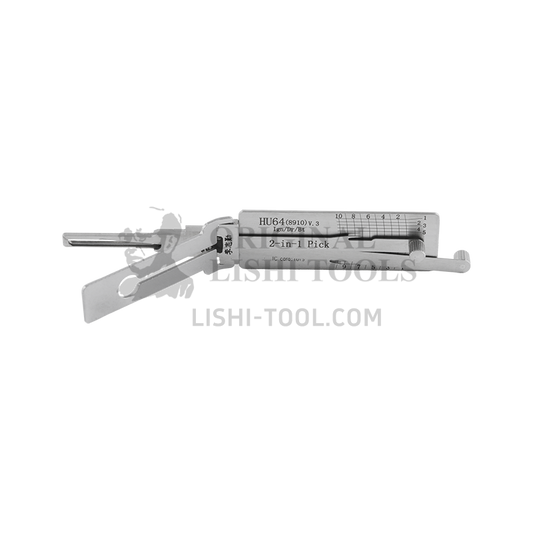
| Mercedes (newer) | HU64 · 10-cut | HU64 v.3 |
| Mercedes (older) | HU39 · 8-cut | HU39 |
| Ford, Jaguar | HU101 · 10-cut | HU101 |
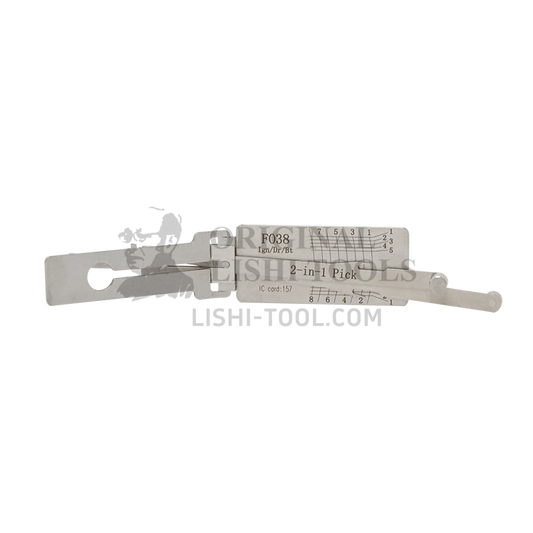
| Ford (older) | FO38 · 8-cut | FO38 |
| GM, Opel, Buick | HU100 · 8-cut | HU100 v.3 |
| Cadillac (newer) | HU100(10) · 10-cut | HU100(10) v.3 |
| Toyota, Lexus (older) | TOY43 · 8-cut | TOY43 |
| Toyota, Lexus (newer) | TOY48 · 5-cut | TOY48 v.3 |
| Honda, Acura | HON66 · 5-cut | HON66 |
| Hyundai, Kia | HY22 · 6-cut | HY22 |
| Nissan, Infiniti, Subaru | NSN14 · 10-cut | NSN14 v.3 |
| Mazda | MAZ24 · 10-cut | MAZ24 v.3 |
| Volvo | NE66 · 8-cut | NE66 |
| Peugeot, Citroen | NE78 · 10-cut | NE78 |
| Renault | HU136 · 8-cut | HU136 |
| Fiat, Jeep Compass | SIP22 | SIP22 |
This table lists the tool most jobs start with. It is not a complete compatibility list — always confirm the keyway against the automotive collection or the application chart before ordering.
Standard, Direct Read and Single Lifter
Three names appear in product titles, and they are not interchangeable:
- Standard — pick and decode with a scale. The default choice for most keyways.
- Direct Read — reads depths directly, useful when the lock cannot be dismantled. The HU92 v.3 is the common example.
- Single Lifter — a single-sided lifter for specific keyways such as HU66 and HU92.
Five mistakes that cost the most
- KW14 and KW16 are Kawasaki tools, not Kwikset. The KW prefix is shared, but these two are motorcycle ignition tools. Kwikset residential tools are KW1 and KW5.
- HU100 is not HU100R. HU100 covers Cadillac, Opel and Buick; HU100R is the newer BMW keyway. Ordering one for the other wastes a week.
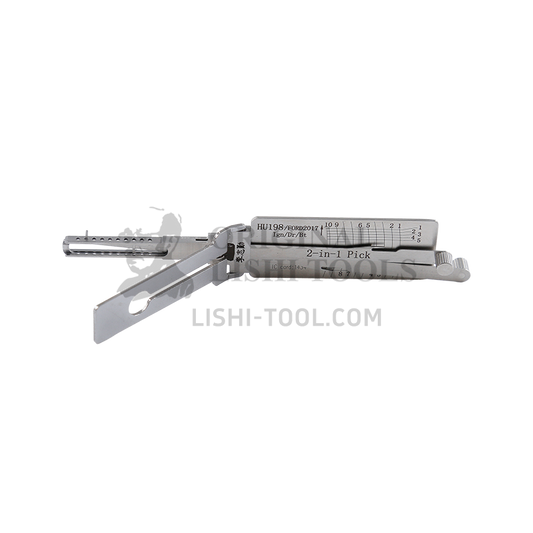
- HU162T has four versions. 9-cut v.2 for 2015+ VW and Skoda, 8-cut v.3, 10-cut for Magotan B8 and newer Audi, and the imported Golf version. Confirm the year before choosing.
- Left groove versus right groove. SC1-L, SC4-L, KW1-L and KW5-L are not substitutes for the right-groove models.
- Buying the 32-piece set first. A set looks efficient, but most locksmiths use five or six tools 80% of the time. Buy the five that match your actual jobs, then fill gaps.
Residential, padlock and mailbox: a short list
For residential work, the three best-selling tools in our store are SC1 for Schlage, KW1 for Kwikset right-groove cylinders and M1/MS2 for Master Lock padlocks. Add SC4 for six-cut Schlage, AM5 for padlocks and BE2-7 for BEST systems. For US mailboxes, the 1646 and NH2/B5 cover the common locks.
Frequently asked questions
Can one Lishi tool open several car models?
Yes — within the same keyway family. An HU66 tool covers many Audi, Volkswagen and Skoda models because they share the keyway, not because every VW uses it.
Does a Lishi tool work on 2020 and newer cars?
It works on the mechanical lock. It does not program immobilisers or bypass electronic security, and some newer vehicles no longer expose a mechanical keyway on the door.
Do I need a key cutter as well?
Decoding gives you the depths; cutting the key needs a cutter or the factory cutter pliers. Budget for both if you plan to cut keys on site.
What if the tool will not read the lock?
Check three things before assuming the tool is wrong: keyway code, cut count, and insertion depth. Our seven-point troubleshooting guide walks through the rest.
Still not sure which tool to order?
Send a clear photo of the key head and the cylinder face through our contact page, with the vehicle year and market. We will confirm the keyway before you buy — that is cheaper than a return.
If you are building a kit from scratch, start with the five tools that match the vehicles you see most often, then add the 32-piece set when you know which gaps you actually have.